Revolutionizing Optical Networks with Dynamic Fiber Coupling Technology
Transforming Free-Space-to-Fiber Optical Communication In the rapidly evolving field of optical communications, researchers have developed a groundbreaking approach to overcome…
Transforming Free-Space-to-Fiber Optical Communication In the rapidly evolving field of optical communications, researchers have developed a groundbreaking approach to overcome…
Breakthrough in Organic Material Patterning Researchers have developed a groundbreaking microlithographic strategy that overcomes long-standing challenges in organic electronics manufacturing.…
The Intersection of Urban Waste Management and Public Safety Recent research leveraging Vision AI technology has uncovered profound connections between…
Scientists have achieved a breakthrough in controlling electronic properties across atomically thin layers using moiré patterns. The research reveals how these quantum effects can influence materials from surprisingly large distances, opening new possibilities for advanced electronics.
Researchers have demonstrated a novel method for achieving long-range electronic control in quantum materials, according to reports published in Nature Communications. The study reveals how moiré patterns – interference patterns formed when two atomic lattices are overlaid – can influence electronic behavior across multiple layers of material, potentially enabling new approaches to quantum material design.
Scientists have created cube-shaped microrobots that self-assemble from origami membranes and feature integrated solar cells for power generation. These miniature devices can communicate via light signals and propel themselves through water electrolysis, representing a breakthrough in autonomous microsystems.
Researchers have developed a novel approach to creating self-assembling microrobots using origami-inspired techniques, according to reports in Nature Electronics. The team from Chemnitz University of Technology and the European Centre for Living Technology in Venice has created thin membrane structures that autonomously fold into three-dimensional cube-like robots capable of forming more complex arrangements through self-assembly.
The AI Paradox: Unprecedented Potential Meets Systemic Fragility We stand at a critical juncture in artificial intelligence development. Large language…
What Drove AppLovin’s Extraordinary 64% Stock Rally? AppLovin’s recent stock performance has captured market attention with a staggering 64% surge,…
The Persistent Touch ID Advantage While many Apple enthusiasts have been anticipating Face ID’s arrival on Mac computers for years,…
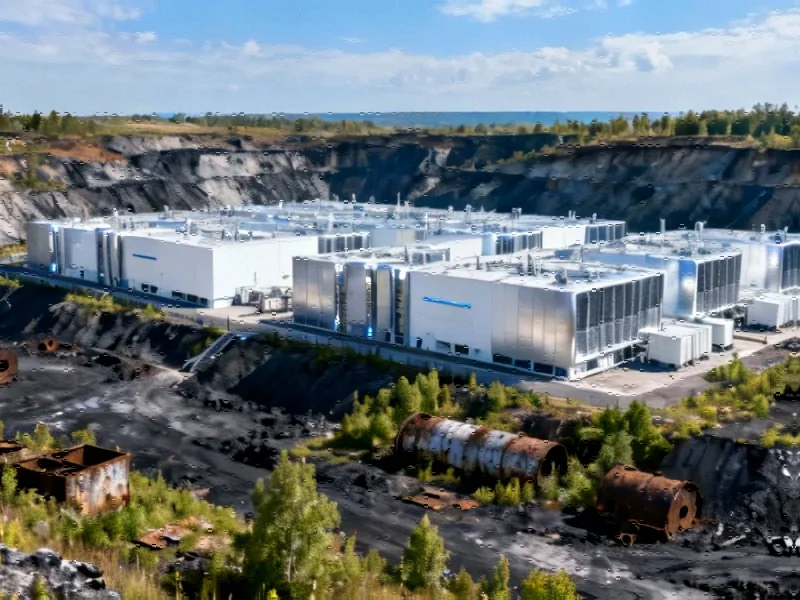
A massive data center project has been proposed for the site of a former Pennsylvania coal mine, promising significant job creation and economic revitalization. The development would utilize natural gas infrastructure and river access for power and cooling systems while representing a shift in coal mining land use.
A transformative project is being proposed for the site of a former coal mine in Greene County, Pennsylvania, where developers plan to construct a massive data center spanning approximately 1,400 acres. According to reports, the development would represent a significant repurposing of the former Robena Mine property along the Monongahela River, potentially creating over 1,000 jobs during construction and beginning operations as early as 2029.
Barclays’ Bold Bet on Semiconductor Equipment Leader In a significant market move, Barclays has elevated KLA Corporation to its top…