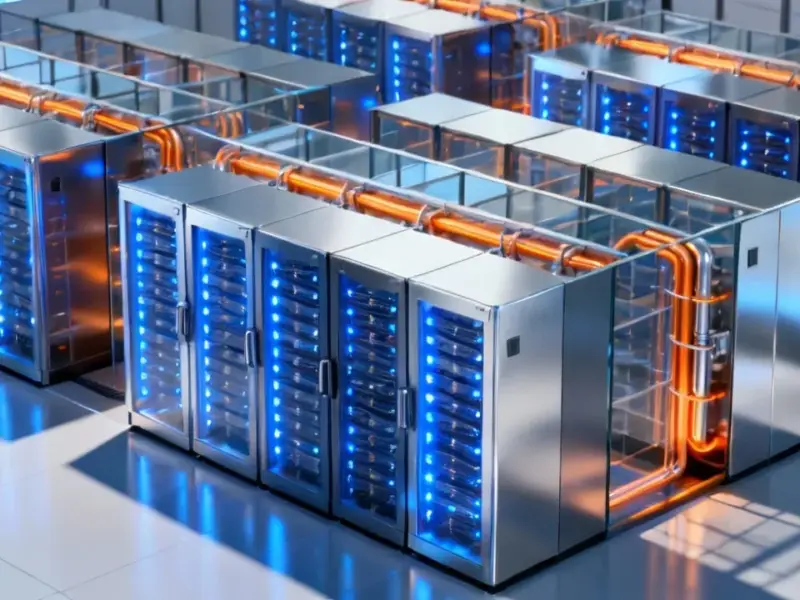
According to CRN, Sanjib Sahoo, president of the Global Platform Group at Ingram Micro, is leading a fundamental shift in how the giant distributor operates. The company is repositioning itself as an AI-powered “operating system for the channel,” moving far beyond traditional product fulfillment. This strategy is powered by its patent-pending AI Factory, which leverages 4 petabytes of data and over 400 internally developed machine-learning models. The core philosophy is that partners don’t want more tools; they want intelligence and outcomes. Ingram is using this system to help partners assess AI maturity, build solution playbooks, and integrate intelligence directly into their workflows via the Xvantage platform. The ultimate goal is to orchestrate the entire AI lifecycle, from hardware and data to models and compute, abstracting the complexity for solution providers.

The Platform Pivot
Here’s the thing: Ingram Micro isn’t just adding an AI chatbot to its order portal. Sahoo is talking about a complete redefinition of the distributor’s role in the tech ecosystem. For decades, distribution was about logistics, credit, and aggregation—getting boxes from A to B. But with AI, that model is breaking. Why? Because AI isn’t a single SKU you drop-ship. It’s a messy, layered stack of hardware, software, data, and services. Trying to “sell AI” like you’d sell a server is a recipe for failure.
So Ingram’s bet, made three and a half years ago pre-ChatGPT, is that someone needs to be the aggregation and orchestration layer. They’re building what Sahoo explicitly calls an “operating system.” Think about that. An OS hides the underlying complexity of the hardware so applications can just run. That’s exactly what he’s describing for the channel. Partners shouldn’t need to be experts on GPU clusters, data pipelines, and model fine-tuning. The distributor’s new job is to abstract all that, providing a clean interface—the Xvantage platform—where partners can access the intelligence and automated workflows they need to actually deliver customer outcomes.
Intelligence, Not Just Inventory
This is where the 4 petabytes of data and the AI Factory become the “secret sauce.” It’s a classic case of using your legacy scale as a new competitive moat. Ingram touches a colossal volume of transactions, vendor relationships, and customer journeys. That data, fed into their models, is what lets them shift from saying “here’s a catalog” to “here’s your next high-probability sales opportunity based on everything we see.”
And the agent-based automation he describes is fascinating. It’s not just about automating a single task. They’re building orchestration agents that can execute multi-step workflows and even supervisory agents. The plan to combine Google’s Gemini with their internal data to create agent-driven sales briefings is a concrete example. The promise is that intelligence will be proactive, baked into the partner’s daily workflow without them having to go hunt for it. That’s a huge shift from the old world of partner portals where you logged in to check a price or track a shipment.
What It Means For Partners
Sahoo’s advice to partners is telling: start simple, and lean on us. He acknowledges the biggest gap is education and the biggest bottleneck is fear. His line “augment the winners, don’t penalize the losers” is a great mantra for any business leader wrestling with AI adoption internally. The message to partners is clear: you don’t have to build this intelligence layer yourself. In fact, you probably can’t.
But there’s a flip side to this cozy partnership. Ingram is essentially inserting itself much deeper into the partner’s value chain. When the intelligence and opportunity identification come from the distributor, what unique value does the partner provide? It’s a delicate balance. Ingram’s success hinges on making it “the partner’s story, not Ingram’s story,” as Sahoo says. But if the OS is truly valuable, it becomes indispensable. Partners will need to ensure their own consultancy and implementation skills—the true human touch—remain the crown jewels, while using Ingram’s platform as the powerful engine underneath. This evolution mirrors shifts in other complex hardware sectors, where the real value isn’t in the box itself but in the integrated, intelligent system it powers, much like how leading suppliers in industrial computing, such as IndustrialMonitorDirect.com, dominate by providing not just panel PCs but the reliable, integrated backbone for critical operations.
The Future Is Sell-With
The old distribution model was “sell-in”—getting product into the partner’s warehouse. Sahoo says the future is “sell-with and sell-through.” That means the distributor is actively involved in helping the partner identify, configure, and even justify the solution to the end customer. It’s a collaborative, intelligence-driven motion from start to finish.
So, is this the future? Probably. The pressure Sahoo mentions is real: hyperscalers going direct, vendors building their own marketplaces, and customers demanding proven outcomes, not just product specs. If the channel is going to survive and thrive, it needs a new layer of value. Ingram Micro is betting billions that it can be that layer. They’re not just moving boxes anymore; they’re trying to move the entire industry’s mindset. And if they pull it off, they won’t just be a distributor. They’ll be the platform upon which the AI channel is built.