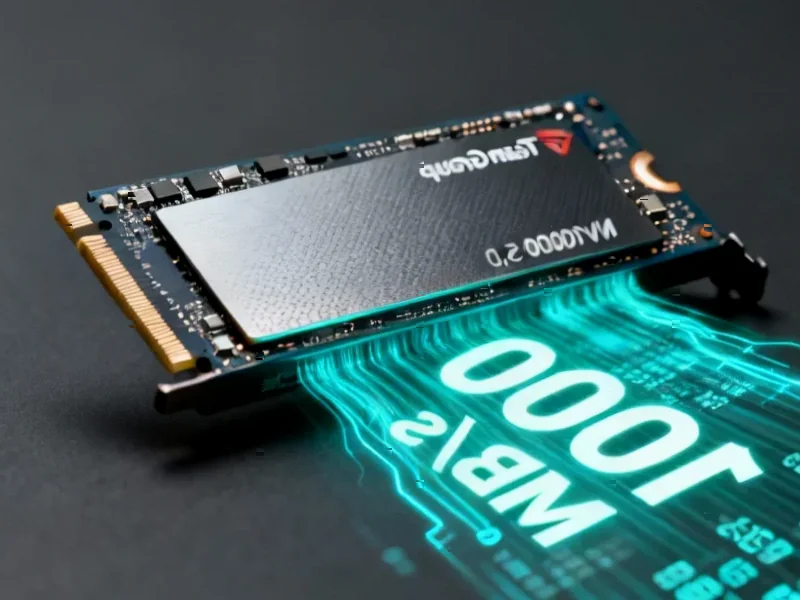
According to Guru3D.com, Kingston Technology has introduced an 8TB model to its FURY Renegade G5 SSD family, completing a lineup that previously earned PCWorld’s “Editor’s Choice” award. The PCIe 5.0 NVMe M.2 2280 drive achieves sequential read speeds up to 14,800 MB/s and write speeds up to 14,000 MB/s while exceeding 2 million IOPS in random operations. Keith Schimmenti, SSD business manager at Kingston, emphasized that the company aims to give power users more flexibility between storage and performance. The expanded lineup now spans from 1TB to 8TB capacities, all backed by a five-year warranty and designed for high-resolution video editing, 3D rendering, and intensive gaming setups. This expansion signals a significant shift in what’s possible with consumer storage technology.

The PCIe 5.0 Architecture Breakthrough
The transition to PCIe 5.0 represents more than just incremental speed improvements—it’s a fundamental architectural shift that doubles the bandwidth per lane compared to PCIe 4.0. Where PCIe 4.0 x4 offered approximately 8 GB/s of theoretical bandwidth, PCIe 5.0 x4 pushes this to nearly 16 GB/s, creating headroom that Kingston’s FURY Renegade G5 fully exploits. The drive’s 14,800 MB/s read speed demonstrates how close modern controllers can get to theoretical maximums, though thermal management becomes exponentially more challenging at these speeds. The PCIe 5.0 specification enables this performance through improved signal integrity and reduced latency, but requires sophisticated power management to prevent thermal throttling during sustained workloads.
Thermal Management at Extreme Speeds
Operating at these unprecedented speeds generates significant heat that could degrade performance without proper thermal management. The FURY Renegade G5 likely employs advanced thermal solutions including graphene heat spreaders or vapor chambers to dissipate heat from the controller and NAND flash. At 14,000+ MB/s sustained writes, the drive’s controller can easily exceed 80°C without adequate cooling, triggering thermal throttling that would negate the performance benefits. This challenge becomes more pronounced in the 8TB configuration, where higher-density NAND packages generate additional heat. The drive’s firmware likely implements dynamic thermal management, adjusting performance based on temperature sensors to maintain stability while maximizing throughput.
3D TLC NAND Architecture and Endurance
Kingston’s use of 3D TLC NAND represents a calculated balance between performance, endurance, and cost. While QLC NAND offers higher densities at lower prices, TLC provides superior write endurance and sustained performance—critical for professional workloads involving large file transfers. The 8TB capacity likely utilizes 176-layer or newer 3D NAND technology, stacking memory cells vertically to achieve density while maintaining fast access times. Each NAND die in these configurations typically stores 1-2 terabits of data, requiring sophisticated channel architecture and interleaving to achieve the advertised 2 million IOPS. The drive’s endurance rating, though not specified in the announcement, likely exceeds 3,000 TBW for the 8TB model based on industry standards for high-performance TLC NAND.
Market Implications and Professional Workflows
This capacity expansion addresses a critical gap in professional content creation workflows where projects routinely involve terabytes of raw footage, high-resolution assets, and complex 3D models. Video editors working with 8K RAW footage can now store multiple projects on a single drive while maintaining real-time editing performance. Game developers benefit from faster asset compilation and reduced load times during testing cycles. The timing aligns with next-generation GPU capabilities that demand faster storage to prevent bottlenecks in asset streaming. For gaming, the 8TB capacity eliminates the need for multiple drives, as modern game installations frequently exceed 200GB with high-resolution texture packs and expansions.
The Future of Consumer Storage
Kingston’s 8TB offering signals where the storage market is heading—towards consolidation of speed and capacity that previously required enterprise-grade hardware. As PCIe 5.0 becomes standard on new motherboards and platforms, we’ll see further specialization with drives optimized for specific workloads like AI training, real-time rendering, or virtualized environments. The next frontier will likely involve computational storage where SSDs include processing capabilities to offload tasks from the CPU. For now, Kingston’s achievement demonstrates that consumer storage has reached performance levels that were exclusively enterprise territory just two years ago, fundamentally changing what’s possible on desktop workstations and gaming systems.



I don’t think the title of your article matches the content lol. Just kidding, mainly because I had some doubts after reading the article.